Status: designed, not printed yet. The test coupon is the next print. Photos of the real thing will replace the renders here.
- The job: hold a 64 oz jug under the big water filter so it fills by itself (about 40 seconds a jug) without anyone holding it.
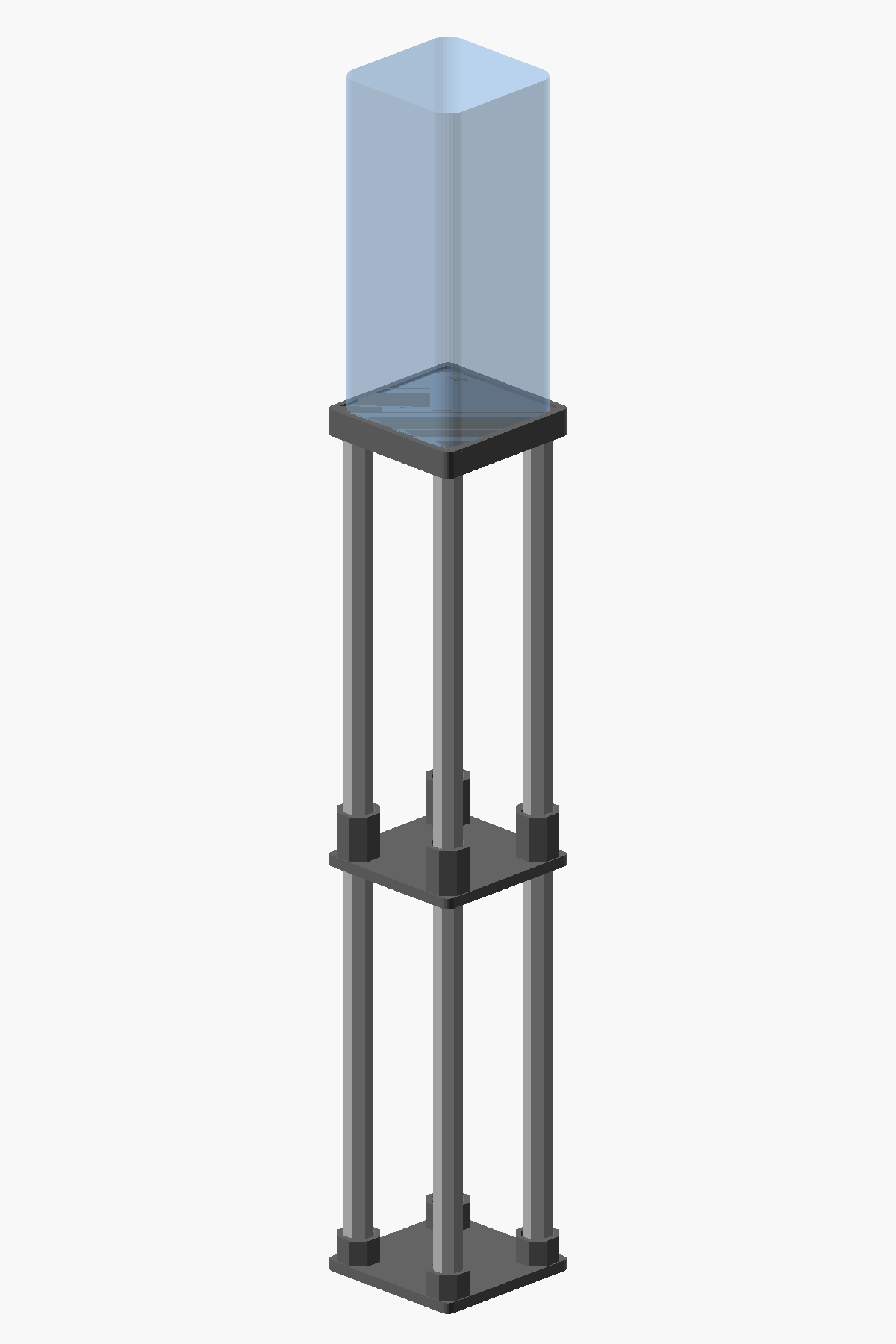
- The shape: 5 × 5 inches, 27 inches tall, two levels, three plates joined by eight press-fit poles.
- The catch: each pole is 333.6 mm long and the printer is 320 mm tall, so the poles print lying down.
The brief
James's spec, in his terms: a square stand about 27 inches tall, two levels so the parts fit the printer, plates about a third of an inch thick, four round poles press-fitting into each plate, and a lip on the top plate to hold the jug loosely and catch spills. The jug is a Nalgene 64 oz growler that he measured at 4.5 × 4.5 × 10.5 inches. The footprint stays at 5 inches so it clears the cabinets.
| Item | Value | Source |
|---|---|---|
| Total height (floor to top of lip) | 685.8 mm (27.00 in) | James |
| Footprint | 127.0 mm square (5 in) | James |
| Mid and bottom plates | 8.47 mm (1/3 in) | James |
| Top plate | 19.05 mm (3/4 in) | Design change, see below |
| Lip | 2 mm tall, 5 mm wall | James |
| Jug pocket vs jug | 117.0 mm vs 114.3 mm, 1.35 mm per side | Jug measured by James |
| Poles | 8 × 333.6 mm, 22 mm across flats | Solved by the model |
Why the poles lie down
The three plates leave 25.5 inches of open height for two levels of poles, and each pole also has to reach into a socket at both ends. That makes each pole 333.6 mm, which is taller than the 320 mm the H2C can print. Lying flat, the same pole fits across the bed with room to spare.
Lying down is also the stronger way to print it. A standing pole is a stack of layers, and a sideways push snaps it along a layer line. A pole printed flat has its layers running the full length. The poles are octagons rather than round because a flat-bottomed octagon prints with no supports. A round pole on its side would need supports under it. The octagon also stops the poles from turning in their sockets.
How the joints work
Every plate prints flat on the bed with nothing hanging in the air. The bottom and mid plates grow octagonal bosses upward, and the poles press into them. The mid plate takes a pole from below and a pole from above, with a 4 mm solid web between them. The top plate is the exception. Its sockets have to open downward while its lip faces up, so it cannot have bosses. Its sockets are blind holes in the plate itself, and at 1/3 inch there was no depth for one. So the top plate is 3/4 inch thick. That is the one place the design departs from the brief, and the poles get slightly shorter to keep the total at 27 inches.
Where the 27 inches go
The model solves for the mid-plate height so that all eight poles are the same length. Any pole fits any socket.
The parts
| Part | Qty | Prints as |
|---|---|---|
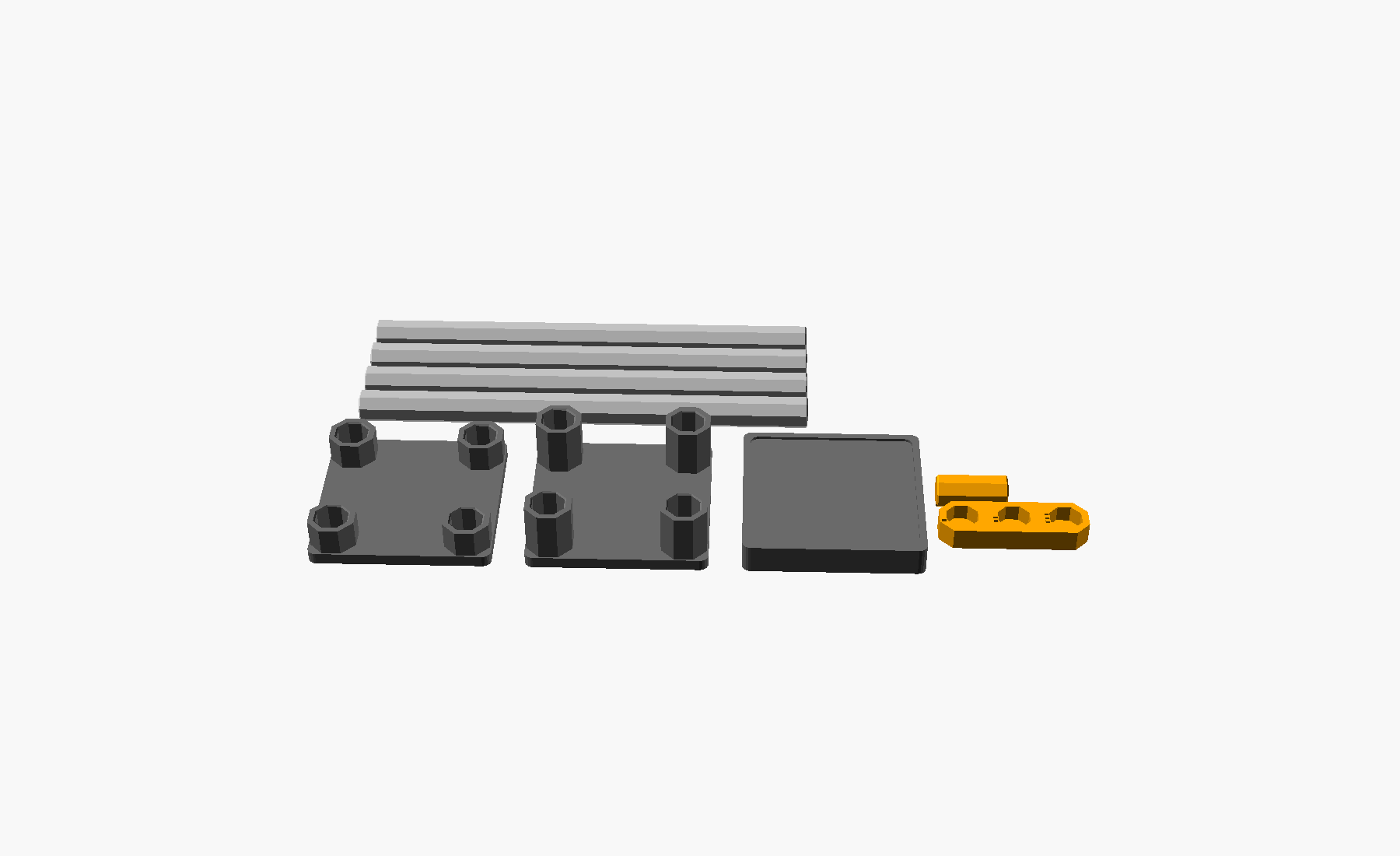
| Bottom plate | 1 | Plate on the bed, four bosses up, 20 mm sockets |
| Mid plate | 1 | Plate on the bed, bosses up, 20 mm socket from each side |
| Top plate | 1 | Underside on the bed, lip up, 15 mm blind sockets from below |
| Pole | 8 | Lying on a flat, 333.6 mm long, 1 mm chamfer on each end |
| Fit coupon | 1 | Three sockets plus a 50 mm pole stub |
Material is PETG, not PLA, because PLA creeps under a load that never comes off.
Test piece first
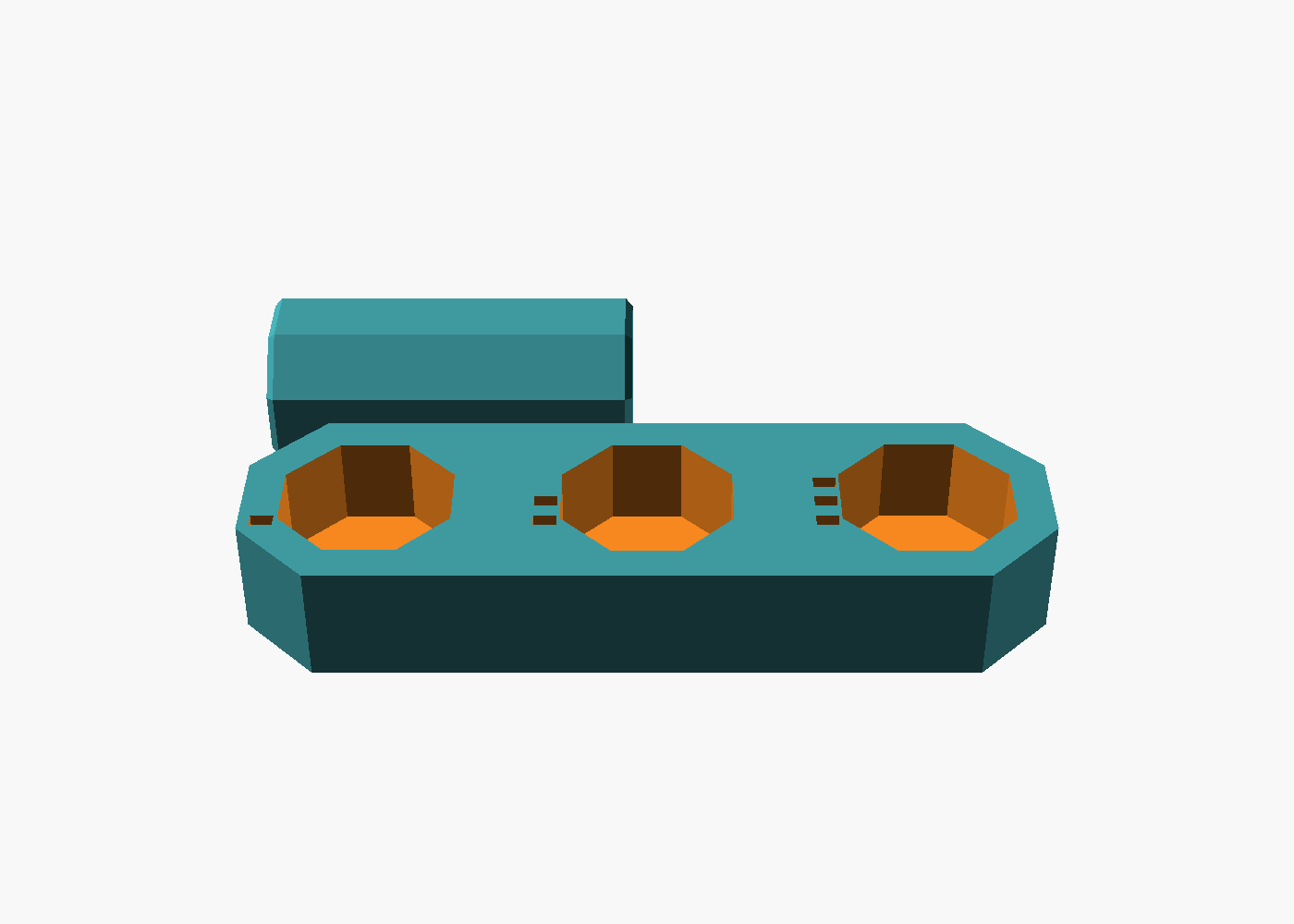
Press fits live or die on a few tenths of a millimetre, and printed holes usually come out a little small. Before spending filament on eight long poles, the coupon prints three sockets at +0.00, +0.15 and +0.30 mm over the pole size, marked with one, two and three notches, and a short stub of the real pole printed the same way as the real poles. The socket that takes the stub with a firm push and does not wobble sets the gap for the whole stand. Changing it is one number in the model.
Known trade-offs
- It is narrow for its height. With a full jug on top (about 2.1 kg) the balance point sits about 819 mm (32 in) up over a 5-inch base. By our estimate, a sideways push of roughly 1.6 N at that height would tip it. That is the worst case, ignoring the stand's own weight. The footprint is set by cabinet clearance, so placement matters: put it where nothing bumps it.
- The lip locates the jug; it does not catch an overflow. The gap around the jug inside a 2 mm lip holds about 1.2 mL. The filter delivers about 47.3 mL a second (64 oz in about 40 seconds). The lip keeps the jug centred under the spout.
What's next
- Print the coupon in PETG and pick the gap.
- Print the three plates and eight poles, assemble, load a full jug.
- Replace these renders with photos of the real stand.
The design is parametric OpenSCAD: one file of measurements (the jug and the brief), one model file, and every part exported in print orientation.