We already run speech-to-speech. Hugging Face speech-to-speech is the Realtime backend for Reachy. The stock conversation app stays on the body. The interesting next experiment is not a new robot stack. It is removing Whisper and letting a multimodal model hear the turn.
What we run today
Reachy is a cascade, not a single speech model. Silero VAD ends the turn. Local Whisper large-v3-turbo writes English. Grok answers in text. ElevenLabs speaks. Kitchen audio stays on the LAN. Only text leaves.
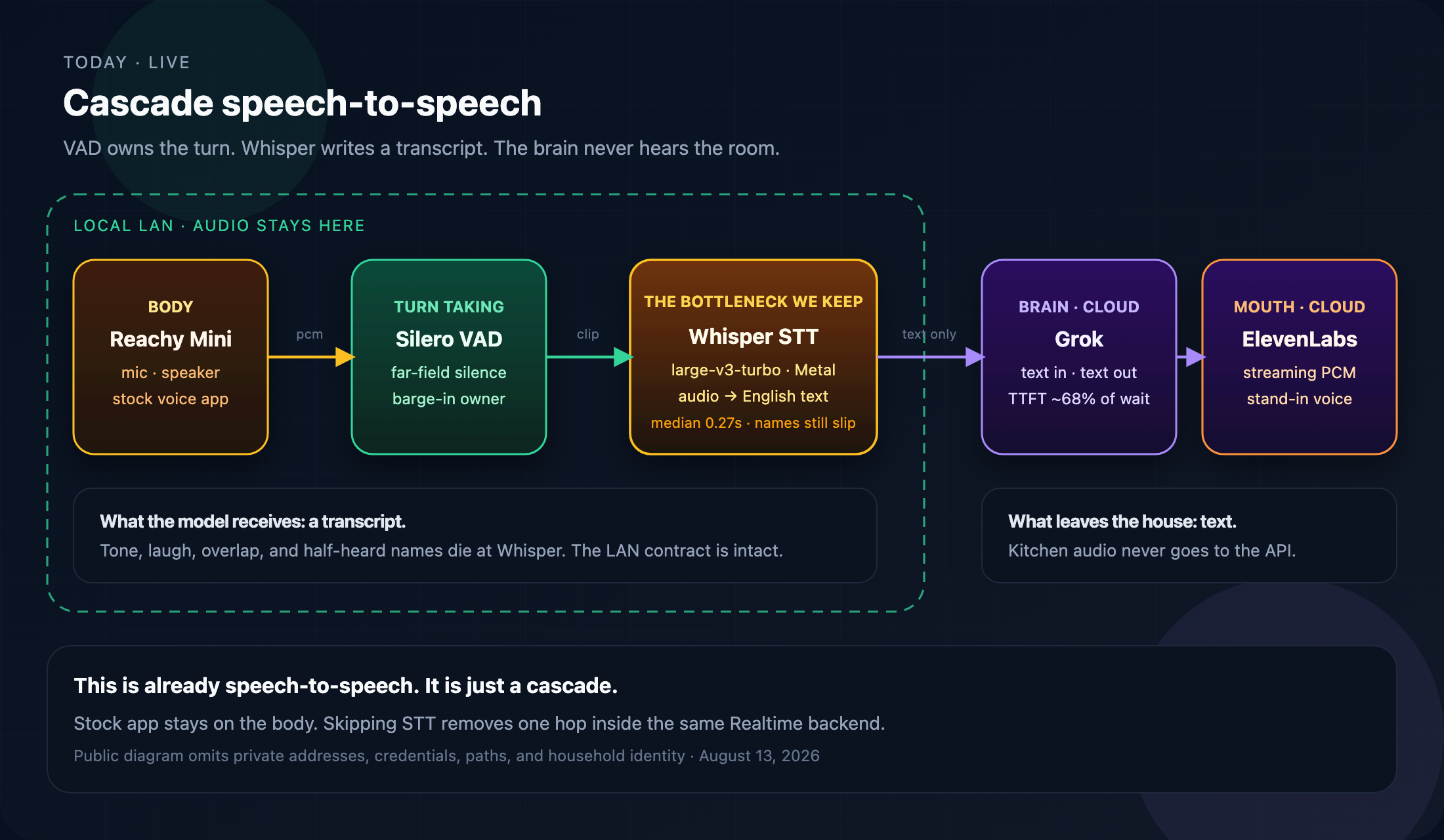
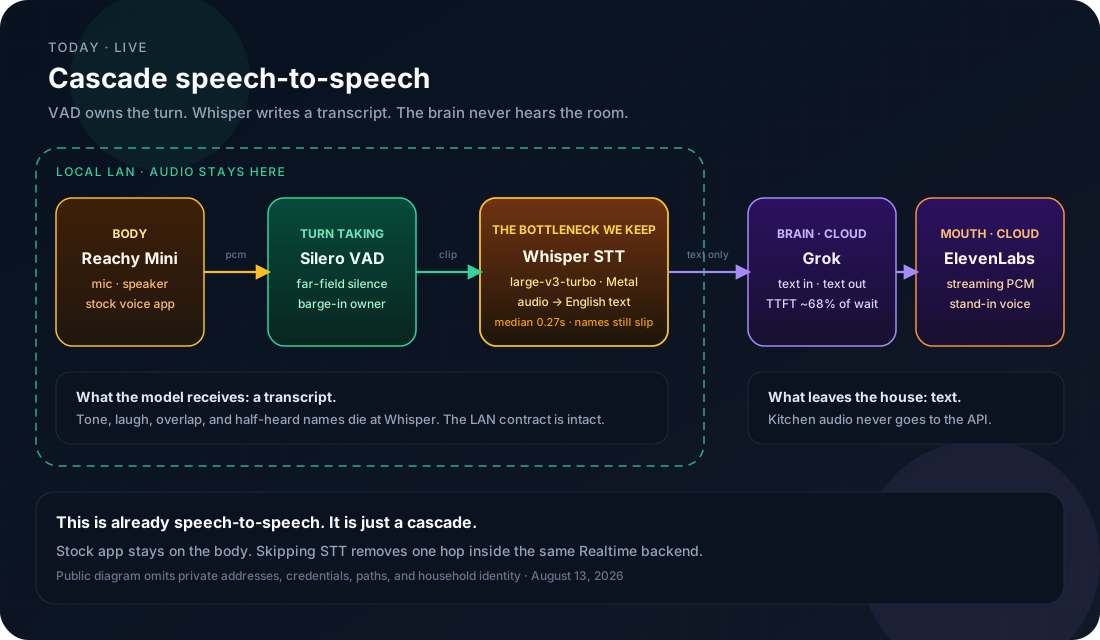
We measured this pipeline on July 27. Soft-end to transcription was a 0.27 s median over 20 turns. Grok time-to-first-token was 2.2–3.1 s, about 68% of the wait to first sound. ElevenLabs first audio was ~0.25 s. Deleting Whisper does not make the robot feel fast. It changes what the brain is allowed to hear.
| Hop | Owner | What it emits | Why it exists |
|---|---|---|---|
| VAD | Local | A finished 16 kHz clip | Far-field turn-taking and barge-in |
| STT | Local Whisper | A transcript | Grok cannot hear audio |
| LLM | Cloud Grok | Reply text + tools | Identity, memory, short answers |
| TTS | Cloud ElevenLabs | Streaming PCM | A mouth. Local clone is still parked |
Why skip STT
Not for latency. For the class of failure Whisper invents: fluent wrong English, “Big Mile,” a laugh turned into words, a name that only exists in audio. The model never sees the evidence. It only sees the guess.
Inkling is a Thinking Machines multimodal model. Audio, image, and text go in. Text comes out. It is not a talker. Official cards put Inkling-Small at 276B total / 12B active. Hugging Face’s own realtime demo is still cascade: mic → Inkling → Qwen3-TTS. Skipping STT means using the audio input they already trained, not pretending we bought Moshi.
What we would not get: native full duplex, spoken tokens, or a private voice. Inkling does not replace the mouth. It does not unlock act-from-voice. Those stay parked.
The skip-STT path
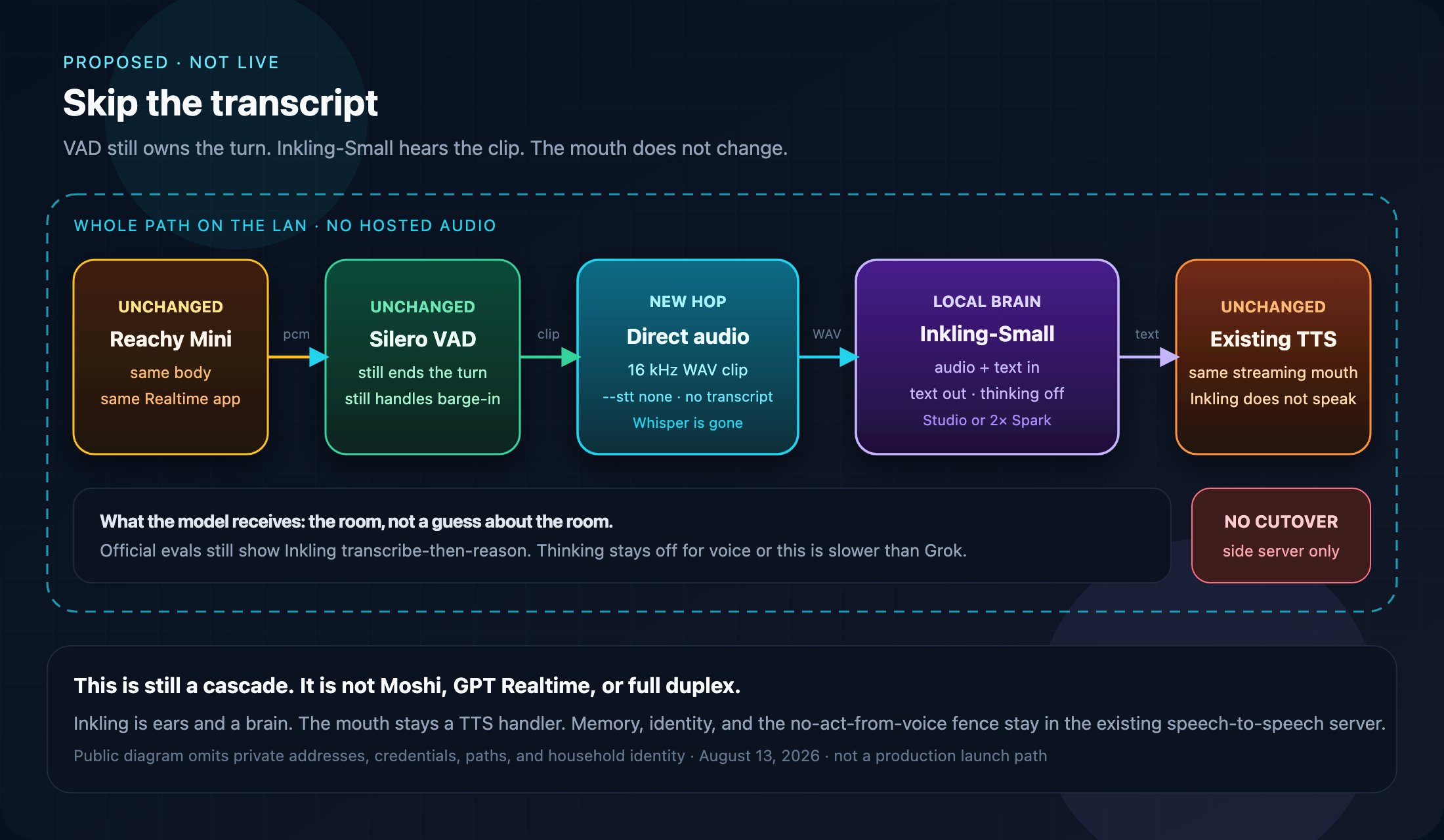
Keep the body, the VAD, the Realtime dialect, the memory layer, and the current TTS handler. Delete the transcript. Send the finished VAD clip to a local Inkling-Small server. Get text back. Speak it with the mouth we already have.
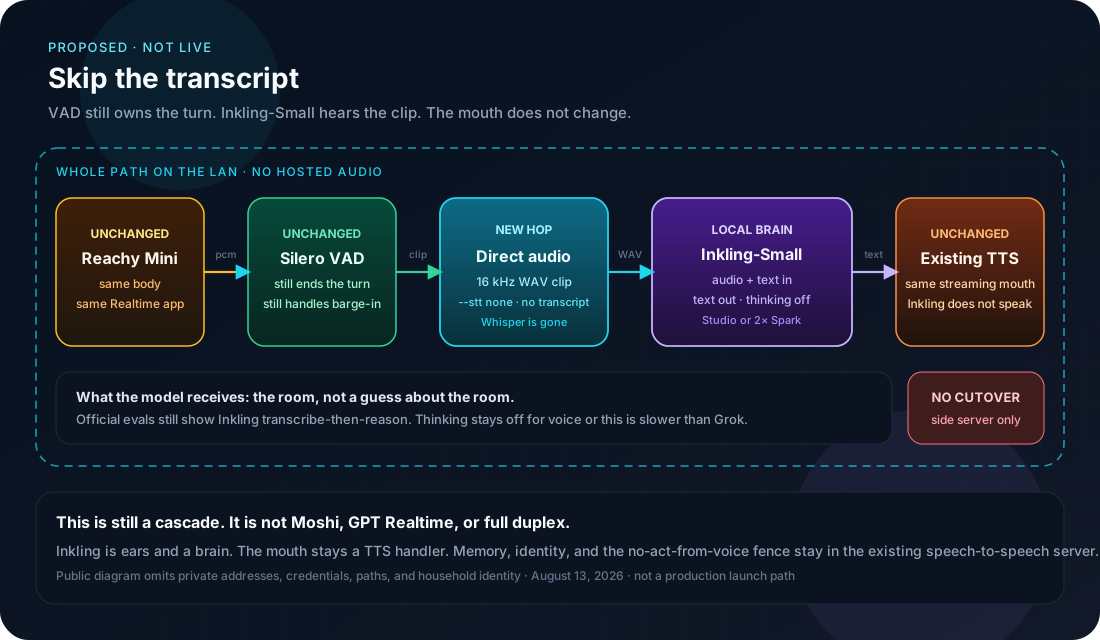
| Piece | Change |
|---|---|
| Stock conversation app | None. It already speaks OpenAI Realtime. |
| VAD / barge-in | None. Still the turn owner. |
| Whisper | Removed on this path only. |
| Brain | Local Inkling-Small, thinking off, OpenAI-compatible chat completions. |
| Memory / identity / no-act fence | Stay in our speech-to-speech handlers. Do not re-litigate. |
| TTS | Unchanged. Inkling does not synthesize speech. |
| Audio leaving the house | Still forbidden. Hosted Inkling is a privacy regression. |
What the wire looks like
Upstream speech-to-speech now has a first-class switch: --stt none with --llm_backend chat-completions. Each completed VAD segment is posted as audio on the chat-completions message, not as a transcript. Responses-API is the wrong slot; a model can accept audio on /v1/chat/completions and still reject /v1/responses.
speech-to-speech serve \
    --stt none \
    --llm_backend chat-completions \
    --model_name inkling-small \
    --responses_api_base_url http://local-inkling/v1 \
    --responses_api_audio_content_type input_audio
That flag set is conceptual. Our live checkout is a dirty tree with local handlers. It does not have --stt none today. A blind git pull is still forbidden. The first implementation belongs in an isolated worktree, not in the production LaunchAgent.
Safer first experiment, if we only want to test Inkling as a brain: keep Whisper and point the existing chat-completions backend at a local Inkling server. That proves text quality and first-token time without merging upstream. Direct audio is the second experiment, after that server is boring.
Where it can actually run
Two machines are available for the brain: the 512 GB Mac Studio (M3 Ultra) and the two DGX Sparks. The voice Mac is a 64 GB M4 Max and cannot hold this model. Unsloth’s table puts Inkling-Small at 89 GB even in 2-bit and 132–170 GB in 4-bit. Hugging Face lists Inkling-Small NVFP4 at 180 GB — a pair-of-Sparks fit, not a 64 GB box. Full Inkling is still a cluster problem.
| Host | Available? | Inkling-Small | Full Inkling |
|---|---|---|---|
| Mac Studio M3 Ultra (512 GB) | Yes | 3/4-bit GGUF | 2-bit maybe; 4-bit / NVFP4 no |
| Two DGX Sparks | Yes | NVFP4 180 GB on the pair | No |
| One Spark (128 GB) | Tight | 2-bit maybe | No |
| Voice Mac (M4 Max, 64 GB) | No | No | No |
Voice needs first token with thinking off, not a 1M-context coding model. Official vibe evals show Inkling transcribe-then-reason on audio. If we leave reasoning on, we will pay more than Grok and hear silence. That is an automatic fail.
How we would run it
Two first-party paths fit the machines we actually have. Full Inkling does not. Nothing below has been launched in this lab yet — these are the official recipes, mapped onto our boxes.
| Box | Engine | Checkpoint | Status |
|---|---|---|---|
| Mac Studio M3 Ultra (512 GB) | llama.cpp Metal | Unsloth Inkling-Small-GGUF UD-Q3_K_XL (3-bit, 128 GB) or UD-Q4_K_XL (4-bit, 132–170 GB) | Documented. Not launched here. |
| Two DGX Sparks | SGLang NVFP4 TP=2 | thinkingmachines/Inkling-Small-NVFP4 (official 180 GB) | SGLang lists a verified 2× GB10 cell. Not launched here. |
| Voice Mac (M4 Max, 64 GB) | — | — | Too small. |
| Full Inkling (975B) | — | NVFP4 600 GB / BF16 2 TB | Neither host. |
Studio: llama.cpp + Unsloth GGUF
Unsloth’s documented Inkling-Small quant for a 512 GB Studio is UD-Q3_K_XL. Metal is on by default; their build notes say set -DGGML_CUDA=OFF on a Mac. Inkling reasons by default. For voice, thinking must be off or we will lose to live Grok on first token.
hf download unsloth/Inkling-Small-GGUF \
    --local-dir unsloth/Inkling-Small-GGUF \
    --include "*UD-Q3_K_XL*"

llama-server \
    --model unsloth/Inkling-Small-GGUF/UD-Q3_K_XL/Inkling-Small-UD-Q3_K_XL-00001-of-00004.gguf \
    --temp 1.0 --top-p 1.0 --min-p 0.0 \
    --chat-template-kwargs '{"reasoning_effort":"none"}' \
    --host 127.0.0.1 --port 8080
Unsloth’s published snippet is llama-cli with those same sampling flags. llama-server is the OpenAI-compatible shape speech-to-speech already speaks. Their build also targets llama-mtmd-cli for multimodal; we have not proven audio-in on this GGUF yet. That is a gate, not a given.
Sparks: SGLang NVFP4 TP=2
SGLang’s Inkling-Small cookbook has a dedicated GB10 image and a verified dual-Spark cell: NVFP4, TP=2, one GPU per node, ConnectX-7. Recipes pass --enable-multimodal so the server accepts audio_url as a base64 WAV. Requests that omit reasoning default to high. Voice must send none.
docker pull lmsysorg/sglang:dev-inkling-small-dgx-spark

# Official cell, not a lab-measured launch:
#   thinkingmachines/Inkling-Small-NVFP4
#   TP=2 across two Sparks over ConnectX-7
#   --enable-multimodal
#   --disable-prefill-cuda-graph
#   Triton attention + Marlin FP4/MoE
# Exact sglang serve line comes from their hardware command generator.
# Docker already wants: --ulimit memlock=-1:-1 --cap-add IPC_LOCK --device /dev/infiniband
vLLM also publishes an Inkling-Small NVFP4 recipe (180 GB, --tokenizer-mode inkling, audio extra vllm[audio]), but the listed hardware is B300 / GB200 / H200, not GB10. There is a community dual-Spark vLLM yaml in eugr/spark-vllm-docker. We are not treating that as first-party, and we have not run it.
What the voice client then sends
Once either server answers /v1/chat/completions, skip-STT is an audio content part, not a transcript. SGLang’s documented shape:
{"type": "audio_url",
 "audio_url": {"url": "data:audio/wav;base64,..."}}
That is the same clip our VAD already owns. Thinking stays off. The mouth stays the current TTS handler.
Sources, fetched August 13: Unsloth Inkling run guide (GGUF sizes and llama.cpp flags); SGLang Inkling-Small cookbook (2× GB10 cell, multimodal, reasoning table); vLLM Inkling-Small recipe (180 GB NVFP4, B300/GB200 hardware); Inkling-Small model card and HF announcement (audio in, text out; BF16 600 GB / NVFP4 180 GB for Small). No tok/s in this section is ours.
How we would stage it
No go implied. If we do this, the order is:
- Stand up Inkling-Small as a side OpenAI-compatible server: llama.cpp GGUF on the Studio, or SGLang NVFP4 TP=2 on the Spark pair. Text-only smoke first. Do not touch Reachy.
- Point a disposable speech-to-speech worktree at that server with Whisper still on. Compare short-turn quality and TTFT against live Grok. Keep thinking off.
- Only then enable
--stt nonein that worktree. Headset first, kitchen later. - Score the same spoken turns both ways: name accuracy, barge-in, first sound, and whether it invents fluent wrong English.
- If it wins as a fallback lane, say so. If it does not, leave the live stack alone.
| Hard fail | Why it stops the experiment |
|---|---|
| Any household audio to a hosted endpoint | Breaks the LAN contract we already published |
| Thinking-on first token worse than live Grok | We already know the budget is the LLM, not STT |
| Kitchen audio worse than turbo Whisper | Then we kept the hard part and lost the easy part |
| Merge into the dirty production tree | The live robot is the rollback baseline |
Still parked: full duplex, private local voice cloning, speaker recognition, guard / code red, and act-from-voice. Direct audio does not earn those.
Companion posts: Reachy Mini: Milo’s Physical Avatar is the live product. One Milo, Many Bodies is the unfinished shared-runtime track. This page is a third thing: a single deleted hop, drawn before anyone types git pull.