GB300 GLM 5.3 Flash Testing
582389ce with sglang#39688 reverted, plus --enable-linear-replayssm-spec. Round 7 traced the numerics drift to #39688: reverting it restores teacher-forced Δ 0.000, and on that image ReplaySSM grows the KV pool from 577K to 857K tokens (+48%) and code single-stream from 288 to 318 tok/s with tools 10/10. Round 8 promoted it, and the C8 aggregate is ~744 tok/s against ~700 on v0.5.20. v0.5.20 stays the rollback. The details are in the recipe. The GB300 has been on other work since October 1, so the daily lane is stopped, not changed. This week's question was the drafter. A weekend on the dual-Spark lane showed the community DFlash2 drafter accepts about 2.3 tokens per verify step on open prose. It did that on every stack we tried, the GB300 included, so the ceiling belongs to the drafter, not the box. We then trained our own drafter on the GB300: 150,000 target-regenerated samples, 18,750 steps, 12.4 hours, every chunk clean. It has not been served yet, so there is no acceptance number for it. That test, and the next steps, are in October 3–8.--enable-linear-replayssm-spec, rejected at boot on September 15, reopened by sglang#40517): it now boots with DFlash and frees the 9.57 GB intermediate SSM buffer — KV pool 577K → 857K tokens (+48%), answer-only C1 +11% history / +13% code, C8 +7%, at the cost of −9.5% on max-effort thinking (it forces fp32 SSM state). Why none of it shipped: the nightly's kernels change the model function — greedy 1/20 against the reference and teacher-forced mean |Δlogp| 0.139 where both controls read 0.000 and 20/20. ReplaySSM adds zero drift of its own (identical numbers with and without), so it is a real candidate the day a clean image carries it. Tools passed 10/10 on every arm and saw none of this; the teacher-forced gate did. Bundle: 2026-09-27-round5-nightly-replayssm. Evening, Round 6 — the drift, bracketed. Seven more boots. The 09-18 nightly (20518d85, 66 commits past v0.5.20) is clean — 20/20, teacher-forced 0.000; the 09-21 nightly (0f6761b5, 314 commits) is not, and every nightly from 09-21 to 09-27 gives bit-identical drift statistics (mean 0.1391908979). That is one deterministic change inside a 184-commit window, not kernel churn — and the later GLM fusions ride on top of it, they are not its cause. The obvious suspect, sglang#40105 flipping SGLANG_FLASHINFER_MOE_FUSED_FINALIZE off "for numerical accuracy", was tested by turning it back on: no effect, falsified. No 09-19/09-20 images exist, so the rest is source builds or an upstream ask. ReplaySSM re-confirmed clean on the same image. 2026-09-27-round6-drift-bisect.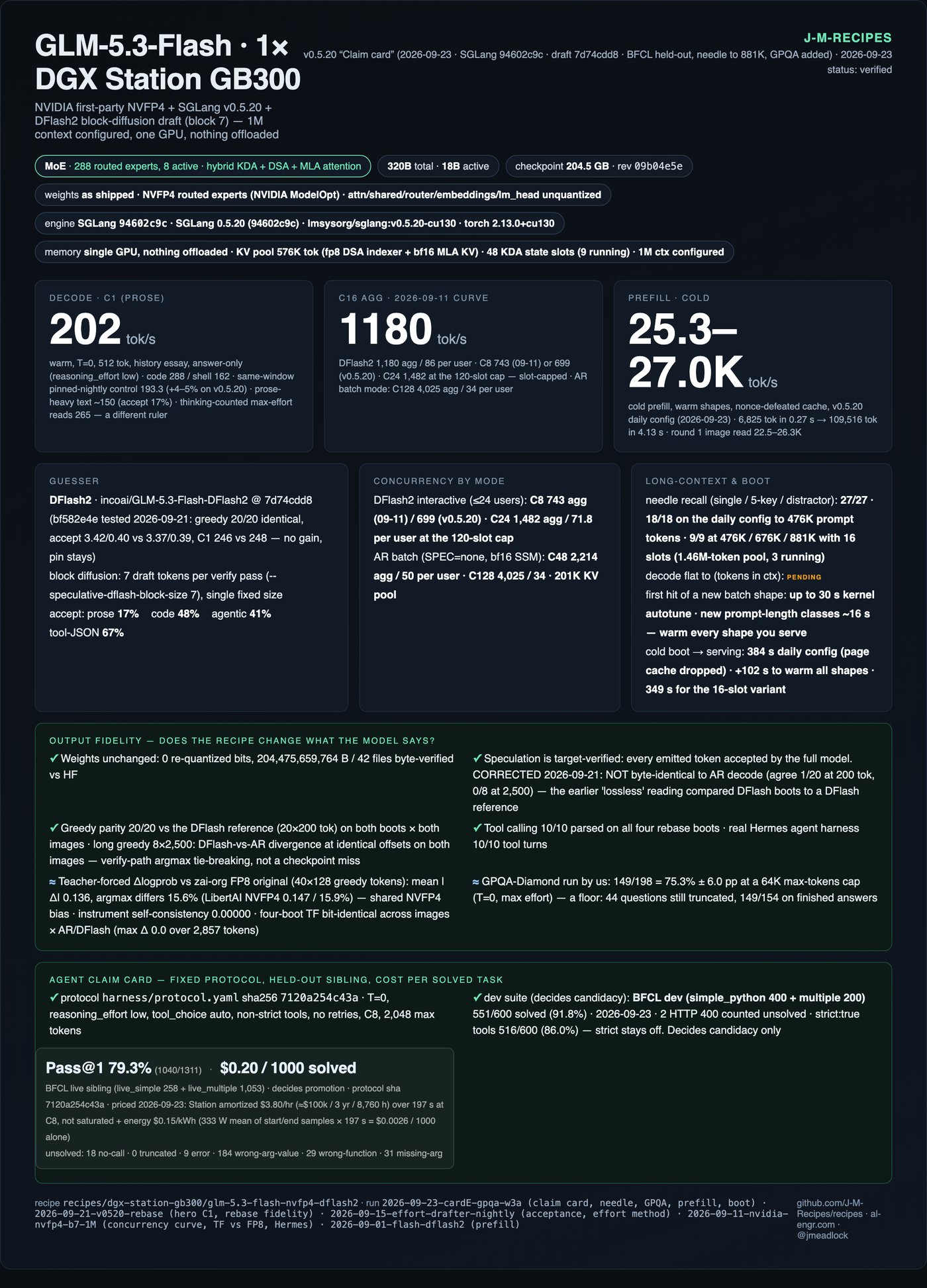
card.yaml. Every number traces to a results bundle; amber means not measured yet.October 15: we served the drafter, and it failed
Where it ran. The plan was to test it on the same Spark pair as the weekend. That lane couldn’t boot, because the Spark1–Spark2 cable is unplugged and the network cards had powered themselves off. So the test moved to the GB300 on a vLLM DFlash lane (one GPU, CUDA graphs on). The target was the same LibertAIDAI NVFP4 aa28e1f bytes the drafter was trained against, with the same chat template. Tok/s on this lane can’t be compared with the Spark numbers. Acceptance can: incoai on the GB300 reproduced the weekend Spark per-position curve to within 0.03 at every prose position, and canada-quant’s published B300 curve to within 0.02. That is one more confirmation that acceptance belongs to the drafter, not the box.
We ran five arms, booting each one fresh: ours at K=4 and K=7, incoai 7d74cdd at K=4 and K=7, and incoai’s newer bf582e4e checkpoint at K=4. Each arm ran the weekend matrix three times, canada-quant’s 500-prompt holdout kit with thinking on, and 300 prompts from our own held-out set.
| Pass bar (set before training) | Ours | incoai, same lane, same morning | Result |
|---|---|---|---|
| Single-stream prose ≥ 2.6 at K=4 | 1.97 | 2.34–2.44 | Fail, and under 2.4, so it is a negative result |
| Agent tool call ≥ 4.33 at K=4 | 4.33 | 4.33 | Pass. 4.33 is the ceiling for a 13-token call, so this bar doesn’t separate the two drafters |
| Code within −0.2 of incoai at K=7 | 2.67 / 2.52 | 3.88 / 3.22 | Fail (−1.21 / −0.70) |
| Thinking-on holdout within −0.1 (canada-quant kit, 500 prompts) | 2.712 | 3.134 | Fail (−0.42, −13.5%) |
What the numbers say:
- It is weaker everywhere, not in one regime. We trained mostly with thinking off, so a gap on the thinking-on kit was expected. But the gap on our own thinking-off held-out prompts is nearly the same size: 2.65 vs 3.03, −0.38. Thinking-on costs only about 0.04 extra at K=4.
- It can’t see as far ahead. The first draft position on prose is close: 0.61 vs 0.65. The gap opens behind it. Position 1 is 0.25 vs 0.34, and position 2 is 0.07 vs 0.20. The drafter knows the next token about as well as incoai does, but its guesses for the tokens after that are mostly wrong.
- Training predicted it. The train-time acceptance estimate of 1.57 looked low on October 8. It was the honest signal.
- The output is unchanged. The big model verifies every draft token, so a weaker drafter never changes an answer. It only makes the answer slower. On this lane that cost is 150 vs 178–186 tok/s single-stream prose at K=4.
- incoai’s newer checkpoint doesn’t move anything.
bf582e4ecame out within noise of7d74cdd(prose 2.34 vs 2.34, canada-quant kit 3.133 vs 3.134).
Likely causes, untested. (1) Scale. We did one pass over 150K samples, against the 736K samples canada-quant used for the drafter that finally edged incoai by 0.044. Our loss was still falling when training stopped. (2) Our loss settings. The 0.5 KL weight was our own guess, not a reproduced recipe. (3) We don’t know how much data Inco used; it isn’t published, and is probably far more than ours. This test measured the failure. It didn’t diagnose it.
Why publish a failure. It is still the only Apache-2.0 drafter we know of that drops into this geometry; incoai’s is CC BY-NC-ND. And the result is useful to anyone who expects a drafter trained on their own traffic to beat a general one. At this scale, it didn’t. The Hugging Face card says “failed experiment” in its title and tells readers to use incoai instead.
October 3–8: the drafter is the ceiling, so we trained one
What we were asking. DFlash2 is a ~1B block-diffusion draft model. It proposes a block of tokens, and the full model verifies them in one pass. How many it keeps per pass (the acceptance length) sets the speed. Earlier rounds on the GB300 reported acceptance from 2.77 to 3.95. Other people's cards report about 3.6. On prose we were seeing less. Was that our box, our quant, our flags, or the drafter itself?
The weekend test (October 3–5, two DGX Sparks, TP2 over RoCE). We used Tony's eager recipe with the incoai drafter 7d74cdd and the LibertAIDAI NVFP4 target aa28e1f, the same bytes as the GB300's first recipe. Every run was greedy with thinking off. The single-stream prose rows are medians of three. The table shows aggregate tok/s, with acceptance length after the slash.
| Arm | C1 prose | C4 prose | C8 prose | C1 structured |
|---|---|---|---|---|
| No speculation (AR) | 15.2 | 38.0 | 42.9 | 15.0 |
| DFlash2, block 7 (K=7) | 19.9 / 2.31 | 31.9 / 2.38 | 35.9 / 2.37 | 64.4 / 7.89 |
| DFlash2, K=4 | 22.0 / 2.17 | 51.4 / 2.22 | 45.0 / 2.23 | 46.7 / 5.00 |
| DFlash2, K=3 | 23.1 / 2.13 | 43.4 / 2.27 | 50.9 / 2.20 | 40.4 / 4.00 |
| canada-quant's patched image, K=7 | 20.1 / 2.36 | 30.8 / 2.38 | 36.3 / 2.41 | 63.0 / 7.89 |
| canada-quant W4A16 target, K=7 | 20.5 / 2.31 | 30.6 / 2.19 | 34.6 / 2.22 | 64.6 / 7.69 |
Three things fell out of it:
- Prose acceptance is ~2.3 everywhere. It stayed there across drafter revision, CUDA graphs, sampling, thinking regime, image, quant (NVFP4 vs W4A16) and K. Per position, a prose block keeps
0.62 · 0.36 · 0.19 · 0.07 · 0.05 · 0.01 · 0.00, so it is dead after position 2. On code the tail stays alive (0.78 → 0.13 by position 6). Our code curve matches canada-quant's published incoai curve to within 0.03 at every position. The 3.6-class numbers come from code- and math-heavy prompts. Our GB300 “2.77–3.95” came from a four-prompt probe whose two prose prompts land at 2.1–2.8 on the Sparks too. There is no hardware gap to chase. - K=7 loses to no speculation at all on prose under load. At C4 and C8 it verifies seven positions to keep about 2.3. K=4 and K=3 stop paying for dead positions: single-stream prose goes up 11–16%, and C4/C8 prose goes up 25–61% against K=7. The trade: structured output tops out at K+1, so at C1 it drops from 64 to 47 tok/s (still 3× AR). Code wants K=7.
- Each lane takes a different thinking switch. The Spark lane's chat template ignores
reasoning_effortand only honoursenable_thinking. The GB300 template is the reverse (see the September 15 correction). A client that sends the wrong switch silently gets the wrong regime.
Bundle for this section: the run directories on Spark1, mirrored in the research notes. They'll go into the recipe repo with the drafter evaluation.
So we trained a drafter (October 5–7, GB300). It uses the same geometry as incoai: 5 layers, hidden size 4096, 1.17B parameters, the same five target taps. That makes it a drop-in replacement for any server that loads incoai. We had two reasons. A drafter trained on the thinking-off prose and agent mix we actually serve is the only lever left for prose acceptance. And incoai is CC BY-NC-ND, so a drafter we train ourselves is one we can release.
| Stage | What happened |
|---|---|
| Data | 150,000 samples, every completion regenerated by the target itself (LibertAIDAI NVFP4 aa28e1f, SGLang, plain decoding, 0 engine errors). The mix is 60K chat (WildChat), 45K Hermes-shaped agent turns (the real Hermes system prompt and tool schemas with public task prompts from ToolACE and glaive; no private session content), 30K code/STEM and 15K structured output. Thinking is off on 77% and on on 23%. Prompt plus completion stays at or under 2,048 tokens. That's 147.2M tokens in total, 92.1M of them supervised. A 2,000-prompt holdout was kept out of training. |
| Trainer | TorchSpec 076a738 (MIT). AngelSpec has no DFlash2 head. The loss is cross-entropy plus top-20 KL against the target's distribution, ported from AngelSpec. The KL weight of 0.5 is our choice; canada-quant doesn't publish theirs. lr 1e-4 → 1e-5 cosine, bf16, one pass, global batch 8. |
| Run | 15 chunks of 10K samples. Each chunk extracts the target's hidden states (~0.48 TB at 49,160 bytes per token), trains on them, then deletes them. Extraction ran at ~7.4K tok/s, which is CPU-bound in the engine core on this stack (batch 64 and four parallel savers didn't move it). Training ran 18,750 steps at 0.8 s/step. Start 01:47, end 14:12 on October 7. All 15 chunks exited clean. |
| Where it ended | Mean of the last 200 steps: loss 2.79, KL 2.47, top-1 train accuracy 0.43. Per block position it falls 0.77 → 0.59 → 0.47 → 0.38 → 0.32 → 0.26 → 0.22. TorchSpec's train-time estimate of acceptance length is 1.57. That is a training-set proxy, not serving acceptance. We have no matching proxy for incoai, so it can't be set against incoai's 2.3. Final checkpoint model.safetensors sha256 bfdf92d2…, plus a midpoint checkpoint at step 9,375. |
| Not done yet | Serving it. Update October 15: now served, and slower than incoai on every prompt mix. See October 15. |
Expectations, stated before the test: canada-quant's 736K-sample run beat the incoai reference by 0.044 on their card. Our own estimate going in was prose 2.3 → 2.6–2.8 at best, worth maybe +10% at K=4. That is reason enough to do it for the licence and the write-up, but not for speed alone.
Next steps, in order
- Done October 15: failed every bar except the ceiling-bound agent bar (results). Serve the drafter beside incoai. Same Spark pair, same day, medians of three, final and midpoint checkpoints. These pass bars were set before training: single-stream prose ≥ 2.6 at K=4 (incoai 2.3); agent tool call ≥ 4.33 at K=4; code within −0.2 of incoai at K=7; thinking-on within −0.1. Below 2.4, it gets published as a negative result.
- Dropped October 15: there is no point re-checking a drafter that lost. Check it against the weights the GB300 actually serves. The drafter was trained on LibertAIDAI's NVFP4. The GB300 daily lane serves NVIDIA's first-party NVFP4. Acceptance across the two quants is a separate measurement.
- Still open, with incoai as the drafter. Blocked until the Spark1–Spark2 cable is back. K=4 as the Spark lane default. It's one integer, gated on a 30-minute C4 soak with memory headroom and agent acceptance holding. K=7 stays on disk as rollback, and as the right setting for code-heavy serving.
- CUDA graphs at K=4. Graphs didn't help at K=7 because the 8-position verify dominated the step. At K=4 the step is shorter, so launch overhead counts for more.
- W4A16 as a lane, not a drafter axis. It binds in 10.5 minutes against ~20 for NVFP4, with the same acceptance. Not yet measured: decode speed without speculation, long-context retrieval, tool fidelity.
- Closed: chasing an “SM121 acceptance gap”, and any more target or overlay swaps expecting acceptance to move. The curve belongs to the drafter.
Credits: Inco for the DFlash2 drafter (CC BY-NC-ND, research and evaluation use); canada-quant for the patched image, both patches and the W4A16 quant; Tony for the dual-Spark lane recipe; LightSeek for TorchSpec.
September 23: what the model does on this box
Tool calling, as a claim, not a smoke test. The recipe now carries a pinned protocol (harness/protocol.yaml: T=0, reasoning_effort: low, tool_choice: auto, no retries, C8). The dev suite (BFCL simple_python + multiple) scores 551/600 (91.8%). The frozen held-out sibling (BFCL live_simple + live_multiple) was run once: 1,040/1,311 (79.3%). The misses are mostly argument values (184). Then come missing arguments (31), wrong function (29), no call at all (18) and 9 HTTP 400s. None truncated. The held-out pass took 197 seconds at C8, which prices at $0.20 per 1,000 solved amortized ($3.80/hr for the Station), plus a quarter of a cent in electricity. These numbers compare candidates on our grader; they are not a leaderboard entry.
One tempting knob lost: marking tools strict: true, which makes SGLang grammar-constrain the arguments, scored 516/600, 35 fewer than non-strict. Strict stays off.
Long context. A needle ladder with three kinds of needle (one key, five keys, a key buried among distractors) passes 18/18 on the daily config from 7K to 476K prompt tokens. The daily config's 576K-token pool stops there, so a second boot traded concurrency for pool: 16 state slots, 1.46M-token pool, 3 running requests. It passes 9/9 at 476K, 676K and 881K, and its single-stream speed matches the daily config. Cold prefill on v0.5.20 is 25–27K tok/s from 7K to 110K tokens. A cold boot to serving takes 384 seconds.
GPQA-Diamond. At 32K max tokens and the model's default (max) effort, 69 of 198 answers hit the cap, which made the raw 64.6% a truncation score. We re-asked those 69 at 64K and merged them back by question index: 149/198 = 75.3% ± 6.0. Even at 64K, 44 questions (22%) still hit the cap and are scored wrong. When the model finishes, it is right 149 times out of 154. So 75.3% is a floor at a 64K cap, not the model's GPQA.
September 23: a speed patch that works and still loses
DFlash2 drafts 7 tokens and the target model verifies all 7 in one pass. On prose, the drafter's acceptance is low (~17%), so most of that verify work is thrown away. W3a kept the 7-token draft and had the target verify only the first K. This took a patch to two SGLang files, with 28 unit tests.
The first run passed every gate: greedy 20/20, teacher-forced logprobs identical, tools 10/10. Its speed matched stock to the decimal, and the reason was the patch's own counter: steps=0 fallback_full_width=4097. It had never run. A diagnostic boot found why. With --tool-call-parser glm47, SGLang attaches a grammar to every chat request, even when no tools are called. The patch skipped grammar steps, so it skipped all real traffic. Every output-equality gate passes when a patch is silently off. The card now fails the boot unless the counter shows the patch running.
The fix builds the grammar mask over the same K tokens the target verifies. A new test using the real GLM grammar shows the K-wide mask equals the first K rows of the full mask: 320 comparisons, 0 mismatches. Rerun against an adjacent stock control, with the patch running on 100% of steps:
| verify width | essay | prose | code | shell | greedy vs stock |
|---|---|---|---|---|---|
| 7 (stock) | 200.4 | 149.9 | 286.1 | 158.8 | 20/20 |
| 5 | +4.0% | +7.0% | −3.0% | +4.2% | 20/20 |
| 4 | +4.8% | +10.5% | −7.6% | −3.2% | 20/20 |
| 3 | +0.2% | +17.6% | −17.8% | −5.5% | 1/20 |
The bar was faster prose and essay with code no worse than −1%. No width clears it. Narrowing helps where the drafter is weak and hurts where it is strong, the same per-class trade the block-size sweep showed in round 3. K=5 and K=4 are lossless against stock. K=3 changes greedy output while the model's logprobs do not move, so something in the narrow decode path differs, and we have not diagnosed it. The patch is parked. The idea that survives is choosing the width per request from recent acceptance. That is untested, and nothing in the recipe depends on it.
Earlier chapters
Round 2 (concurrency and the KL gate), round 3 (the effort ruler and seven closed axes) and the September 21 rebase are summarized in the notes below. The day-one-to-day-two story follows them unchanged, as history.
bf582e4e tested on the v0.5.20 lane against the pinned 7d74cdd8 — greedy 20/20 identical, acceptance 3.42 vs 3.37, C1 246 vs 248, C8 692 vs 699, tools 10/10 ×2. No change; the pin stays.max_running_requests is capped to 7 by the mamba state cache); the C16/C32 DFlash2 numbers were 16–32 clients sharing 7 seats. With the slot budget raised, DFlash2 beats AR per running request through at least C24, and one GB300 serves 128 users on plain AR. Full re-measurement, the KL quality gate against the FP8 original, and the updated recipe: GLM-5.3-Flash Round 2.This is the GLM-5.3-Flash chapter on the DGX Station GB300. Day one ended at 141.8 tokens/second single-stream and two open mysteries. By the end of day two the same box was doing 234 tok/s — a 65% gain from a research round, one warmup discipline, and one draft model. Everything below is reproducible from the open-source recipe. The full 744B GLM-5.3 on the same Station is its own story: GB300 GLM 5.3 Testing.
Get the current recipe on GitHub → (the day-two origin repo, gb300-glm-flash-recipe, is preserved as history)
Start with the map, not the flags
Before touching a single launch flag we ran four parallel research agents against the open questions: quantization options, engine support, speculative decoding, and SGLang tuning. Twenty minutes bought a clear picture. Our stack — SGLang PR #36507 plus the NVFP4 checkpoint — was the only viable path: vLLM's GLM-5.3-Flash support was unmerged and TensorRT-LLM handled the big GLM architecture but not Flash's. More usefully, catid's DGX Station benchmarks gave us numbers on identical silicon: 187 tok/s single-stream with DFlash2 speculative decoding, ~965 aggregate at 16 streams. We were at 141.8 and ~220. The gap was configuration, not physics.
Mystery #1: the concurrency cliff that wasn't
Day one measured a hard wall at 8+ concurrent streams: ~220 tok/s aggregate with 15-second time-to-first-token. The research pointed at CUDA-graph fallback. The logs disagreed — cuda graph: True throughout, and the server was decoding at 700 tok/s internally while clients sat waiting. The real cause was first-hit kernel autotune: every new batch shape pays a one-time JIT and tuning cost after server start. A cold benchmark measures that cost, not the server.
The fix is a procedure, not a flag. After every server start, run one warmup wave at each concurrency level you intend to serve — about 90 seconds total. Warm, the same server does 648 tok/s aggregate at 8 streams and 1,051 at 16. That is a 5× difference that was never a hardware limit. If you benchmark inference servers and skip the warmup, your numbers are wrong.
Mystery #2: speculative decoding
GLM-5.3-Flash has a purpose-built drafter, DFlash2: a ~1B block-diffusion model that proposes 8-token blocks which the 355B model verifies in one forward pass. It is verified-lossless — the output distribution is identical to plain decoding. On prose it lands about 3 accepted tokens per verification (corrected October 8: on open prose it is ~2.3 on every stack we tested; ~3 and up is code and math, see October 3–8), so each expensive big-model pass is amortized across ~3 emitted tokens.
Result: 135.5 → 234.2 tok/s single-stream, ahead of the published 187 on the same hardware. The catch: speculative decoding loses above roughly 16 concurrent streams, where verification passes start competing with batch capacity. The recipe ships both launch configs and says which to use when.

The decode table
| Concurrency | Day one | Tuned AR | DFlash2 | Best config |
|---|---|---|---|---|
| 1 stream | 141.8 | 135.5 | 234.2 | DFlash2 |
| 4 streams | 372 | 376 | 511 | DFlash2 |
| 8 streams | ~220 · 15 s TTFT | 648 | 825 | DFlash2 |
| 16 streams | 216 | 1,051 | ||
| 32 streams | 221 | 1,163 |
Aggregate output tok/s, warm steady-state, 256-token generations, benched on-box. Struck rows corrected September 11 — the DFlash2 server was capped at 7 running requests; see round 2. Machine-readable results, bench scripts, and the failure ledger are in the repo.
Prefill: a novella in four seconds
Long-context ingestion on the production config. Each prompt carries a leading nonce so the prefix cache cannot cheat, and TTFT is counted from the first streamed delta of any kind:
| Prompt | Time to first token | Prefill rate |
|---|---|---|
| 6.6k tokens | 0.29 s | ~22,500 tok/s |
| 26k tokens | 1.10 s | ~24,100 tok/s |
| 53k tokens | 2.01 s | ~26,200 tok/s |
| 105k tokens | 4.00 s | ~26,300 tok/s |
Same warmup rule: the first request in each prompt-size class after a restart pays ~16 seconds of one-time autotune. Warm, a hundred thousand tokens — a short novel — goes in four seconds.
The bug that passed every benchmark
After all the tuning, the server aced every throughput test and then failed in real agent use: tool calls never fired, and chain-of-thought leaked into replies. SGLang needs --tool-call-parser glm47 --reasoning-parser glm45 to turn GLM's tool-call markup into OpenAI-style tool_calls and to split thinking from content. Without them, plain chat works perfectly and anything agentic breaks silently — invisible to every benchmark. The launch scripts now carry the flags. The lesson generalizes: smoke-test the workload you actually serve, not the one that is easy to measure.
One recipe, many weights
Freezing the runtime had a useful side effect: any same-architecture NVFP4 checkpoint is a drop-in. Same image, same flags, same drafter, same client-facing model name. A swap is a container relaunch plus the warmup sweep, and clients never notice. The repo ships swap-model.sh for this; we use it to rotate between the stock checkpoint and a de-guardrailed research variant on the same box.
Measured, not assumed: swapping to Blackfrost's DERISKED variant (modified weights, same architecture) while keeping the stock-trained drafter cost 6.5% — 218.8 vs 234.2 tok/s single-stream — with accept lengths essentially unchanged (2.69–3.69 vs 2.77–3.95). A surgically-modified variant keeps nearly the whole speculative win without retraining the drafter. Total swap including warmup: about eight minutes.
What is in the recipe
- Launch scripts for both configs (DFlash2 for interactive, AR for batch), pinned model revisions, and an image-build script that freezes the runtime so production boots need no network
- The warmup script — the 90 seconds that separates real performance from autotune artifacts
- The failure ledger — all ten failed launches with exact error strings: transformers version traps, AutoConfig collisions, TP-style failures, and the proof that full GLM-5.3 in FP8 (704 GB) cannot fit one Station
- Diagrams — memory budget, serving topology, and how block-speculative decoding works

Driver memory mode
On day three we enabled NVIDIA's Coherent Driver-based Memory Management (CDMM) on the box so the kernel stops allocating into HBM behind the driver's back. Flash throughput did not move — the model already lives entirely in HBM, so there was nothing for the kernel to steal — and the tool-call smoke, warmup sweep, and a single-stream decode probe all re-verified after the reboot. The change matters for offloaded workloads, which is why the details live in the GLM 5.3 post.
Not yet tried
Two leads from the research pass are parked. SGLang's DSpark speculative decoding is built precisely for the concurrency crossover in the table above (verification length shrinks as load rises), but no GLM-5.3-Flash drafter has been published for it. And the frozen image predates a Blackwell FA4 fix and session-aware prefix caching in SGLang 0.5.18 — both worth an upgrade trial the next time we have a reason to re-bench.
Standing on shoulders
This work exists because catid published theirs: the reference numbers, the runtime pins, the recipe discipline. Publishing ours back, failure ledger included, is the repayment. Credits also to LibertAIDAI for the NVFP4 quant, inco.ai for the DFlash2 drafter, and the SGLang PR #36507 authors for the model support everyone is quietly running.
Provenance: all figures measured September 1–2, 2026 on the hardware in the repo README: DGX Station GB300, driver 595.84, CUDA 13.2, SGLang PR #36507, transformers 5.16.1, frozen image glm53-nvfp4-sglang:gb300-v2. Related: GB300 day one · GB300 GLM 5.3 Testing · the Milo-Ark model archive.